
Description
Overview:
Designed by professionals, for professionals
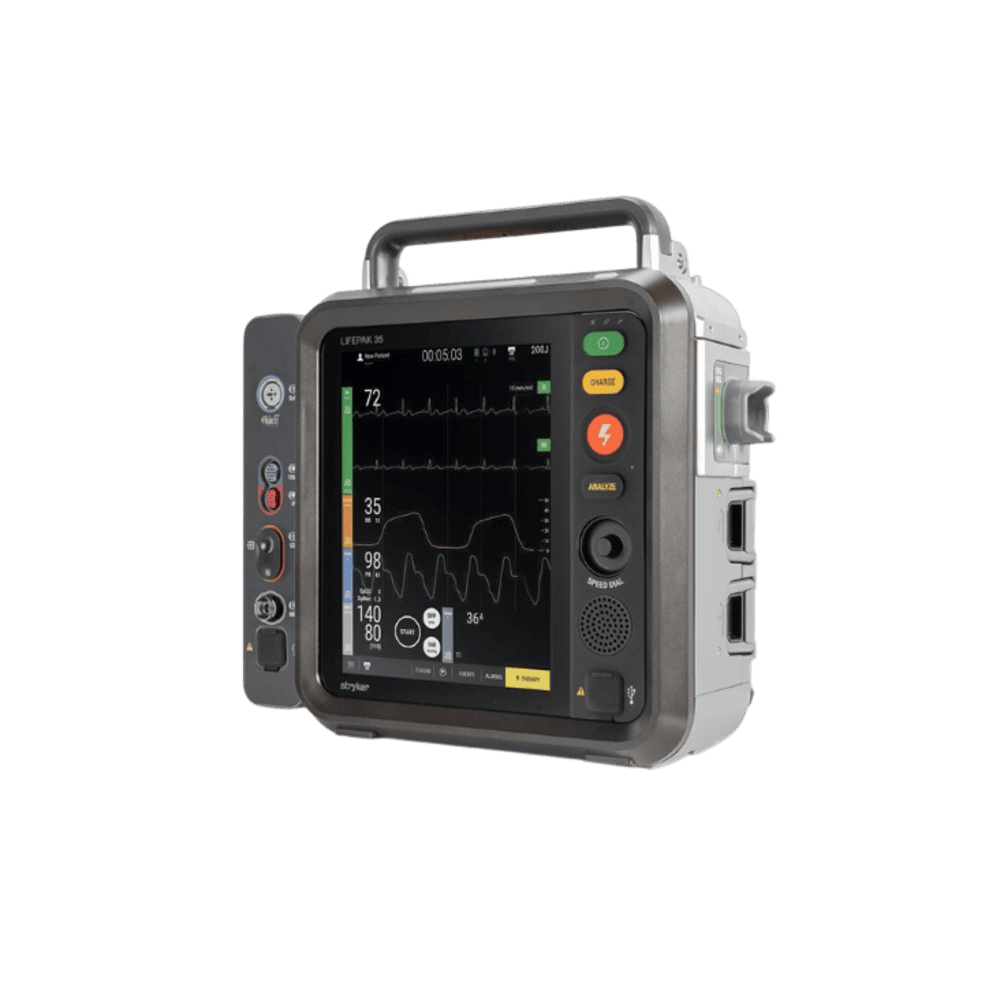
The LIFEPAK® 15 monitor/defibrillator is a high-performance cardiac emergency device built for paramedics and emergency medical teams. It integrates manual defibrillation, automated external defibrillation (AED), and advanced monitoring capabilities, including 12-lead ECG, capnography, SpO₂, and invasive pressure monitoring. Its rugged, ergonomic design is built to perform in demanding pre-hospital and hospital environments. Key features include a dual-battery system, a large color display, and Bluetooth connectivity for seamless data transmission. With escalating energy up to 360J, the LIFEPAK 15 is trusted worldwide for critical resuscitation efforts.
Key Features
- Proven clinical performance you can trust
Escalating energy up to 360J has been shown to improve conversion rates in difficult-to-defibrillate patients.¹⁻⁴ Enhance STEMI care with the industry-leading University of Glasgow ECG Analysis Program and ST-segment trend monitoring, which continuously tracks all 12 leads and alerts you to critical changes. - Efficiency in chaotic settings
From intuitive controls to a dual-battery system and an 8.4-inch anti-reflective color display that switches to high-contrast mode with a single button, the LIFEPAK 15 is designed to help you work efficiently—so you can stay focused on your patients. - Built to endure: LIFEPAK TOUGH durability
With more than a dozen durability enhancements over previous models, the LIFEPAK 15 is the toughest yet—engineered to withstand drops, shocks, and extreme vibrations. - Enhance team response and patient outcomes
The LIFENET System connects the LIFEPAK 15 to the cloud, transmitting critical patient data to the hospital in real time. This streamlines documentation, activates care teams for time-sensitive emergencies, and provides insights for continuous performance improvement. - Simplify device management and maintenance
Ensure the LIFEPAK 15 is always ready with two reliable batteries and a daily self-test that detects potential issues before they become problems. Track device health and readiness effortlessly through the LIFENET Asset Management system.
Device modes
- AED Mode – Basic user operation for automated external defibrillation with voice and visual prompts.
- Manual Mode – Allows advanced users to select energy levels, analyze rhythms, and manually deliver shocks.
- ECG Mode – Uses a 3-wire ECG cable for continuous cardiac monitoring and ECG display without defibrillation.
- Setup Mode – Enables users to configure operational settings, including display preferences and CPR protocols.
- Data Transfer Mode – Supports patient data transfer via Bluetooth, USB, or the LIFENET System for post-event review and analysis.
- Auto Test Mode – Conducts a daily self-check of hardware and software functionality, alerting users to potential issues.
cprMAX Technology settings
- Initial CPR – User-defined CPR duration following the initial analysis (OFF, 15, 30, 45, 60, 90, 120, or 180 seconds).
- Pre-shock CPR – Allows CPR during defibrillator charging (OFF, 15, or 30 seconds).
- Stacked Shocks – Enables or disables CPR after each shock (ON or OFF).
- Pulse Check – Options include a pulse check after each shock, a no-shock-advised (NSA) pulse check, or no pulse check (default: NEVER).
Energy sequence
- Default Energy Levels – 200J, 300J, and 360J for the first three shocks, followed by 360J for all subsequent shocks.
ECG options
- 3-wire ECG cable – Standard monitoring configuration.
- 12-lead ECG – Captures a full 12-lead ECG for advanced cardiac assessment and transmission to hospitals.
- ST-segment monitoring – Continuously tracks ST-segment changes for STEMI detection.
- Interpretation – Uses the University of Glasgow ECG Analysis Program for clinical decision support.
- Display customisation – Adjustable ECG waveform scaling and filtering for enhanced signal clarity.
More details on Stryker’s website here.


Reviews
There are no reviews yet.